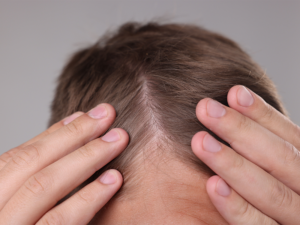
You run your fingers through your hair and something feels different. The ponytail sits thinner. The part looks wider under bathroom light. Your scalp shows through in photos where it never did before. There is no bald patch, no receding hairline, just less hair everywhere at once. If this sounds familiar, you are likely dealing with diffuse thinning, and the question on your mind is a fair one: can diffuse thinning be treated with FUE, or are you out of options?
You are not out of options. But diffuse thinning is different from patterned baldness, and the answer depends on factors worth understanding before you commit to anything. This guide explains what diffuse thinning is, who develops it, why it happens, whether it always leads to permanent loss, and where surgery fits into the picture.
What Diffuse Thinning Actually Is
Diffuse thinning is hair loss spread evenly across the scalp rather than concentrated in one zone. Instead of a receding hairline or a bald crown, you lose density uniformly. The result is a scalp that gradually becomes more visible from all angles.
Here is how to recognize it:
- Overall see-through appearance. Your scalp shows through more in bright light, especially at the crown and mid-scalp.
- Widening part. For women, a part line that keeps getting wider is often the first clear sign.
- Reduced ponytail volume. Hair ties wrap around more times than they used to.
- No distinct bald spots. The loss is general, not localized to one area.
- Steady, not sudden. Most people notice it over months, not overnight.
The tricky part is that diffuse thinning can hide the true extent of loss. Because it spreads evenly, you may lose a significant percentage of density before it becomes obvious to others. That delay often means people wait longer to seek answers than they should.
Who Develops It, and Why
Diffuse thinning affects both men and women, though it presents more visibly in women because of how female hair loss patterns work. Men can experience it too, sometimes as an early or atypical form of genetic loss known as diffuse unpatterned alopecia.
The causes fall into a few broad groups:
- Genetics. Androgenetic alopecia, the hereditary form of hair loss, can present diffusely rather than in the classic pattern, particularly in women and some men.
- Hormonal shifts. Thyroid imbalance, pregnancy, menopause, and changes in hormone levels commonly trigger widespread shedding.
- Nutritional gaps. Low iron, vitamin D, or protein can weaken follicles across the whole scalp.
- Stress and illness. A condition called telogen effluvium pushes large numbers of follicles into the shedding phase at once, often weeks after a physical or emotional shock.
- Medications. Certain drugs list hair thinning as a known side effect.
This range of causes is exactly why diagnosis matters so much. Two people with identical symptoms can have completely different underlying problems, and the right treatment for one may do nothing for the other.
Does Thinning Always Lead to Hair Loss?
No. This is the reassurance you need to hear. Thinning does not automatically mean permanent baldness.
The outcome depends entirely on the cause. When thinning comes from a temporary trigger, such as stress, illness, a nutritional gap, or a hormonal event like childbirth, the follicles are usually still healthy. Once the underlying issue is corrected, hair often recovers on its own. Telogen effluvium, for example, is typically reversible once the trigger resolves.
Genetic thinning is different. When follicles are genetically sensitive to DHT, the hormone that gradually shrinks them, the miniaturization tends to continue without intervention. Left alone, those follicles produce finer, weaker hairs until they stop producing altogether.
So the honest answer is this: some thinning reverses, and some progresses. The only way to know which type you have is a proper evaluation. That is where the team of professionals at Capilar Hair Center in Tijuana begins, by identifying the cause before recommending any solution.

Can Diffuse Thinning Be Addressed With FUE?
Now the central question. Can diffuse thinning be treated with FUE? FUE transplant technique that harvests individual follicles from a donor zone, depends on one critical factor: the health of your donor area.
FUE works by relocating DHT-resistant follicles from the back and sides of your scalp to areas that need more density. The technique is proven and effective, but it relies on having a stable, healthy donor zone to draw from. Diffuse thinning complicates this in a specific way.
Here is the challenge. In classic pattern baldness, the donor area stays thick while the top thins, giving the surgeon a reliable supply of permanent follicles. In diffuse thinning, especially the unpatterned type, the loss can affect the donor region too. If the back and sides are also thinning, harvesting from them risks poor results and may worsen the appearance of the donor zone.
So candidacy comes down to careful assessment:
- You may be a good candidate if your thinning is patterned or stable, and your donor area remains dense and DHT-resistant.
- You may not be a candidate yet if your loss is actively progressing or your donor zone is also affected. In these cases, medical therapy to stabilize the loss usually comes first.
- You may benefit from a combined approach, where treatments like medication or platelet-rich plasma stabilize existing hair, and surgery addresses density later, once the condition is under control.
Timing matters as much as technique. Part of the evaluation involves confirming that your hair loss has stabilized, which is also why the ideal age for hair transplant surgery is assessed individually rather than by a fixed number. A qualified surgeon will not operate on a scalp that is still actively losing hair, because the results would look inconsistent as native hair continues to shed around the grafts.
Your Next Step Toward a Clear Answer
Diffuse thinning is confusing precisely because it hides in plain sight. You see the change before anyone else does, and the uncertainty about what it means, and what you can do, is often the hardest part. You deserve a straight diagnosis rather than a guess.
Start by getting your scalp and donor area properly evaluated. A trained surgeon can distinguish reversible thinning from progressive genetic loss, measure your donor density, and tell you honestly whether surgery is appropriate for your case or whether medical treatment should come first. That clarity is worth more than any assumption you can make on your own.
At Capilar Hair Center in Tijuana, the surgical team uses advanced FUE hair transplant and DHI techniques and begins every case by finding the cause of your loss. If you are a strong candidate, they will tell you. If you are not yet, they will tell you that too, along with what to do about it.
Contact Capilar Hair Center today and get the honest assessment you and your hair deserve. If this article is helping you, you can check out, How Density Optimization In Hair Transplant Surgery Works or Hair Transplant Financing For International Patients at CHC.